Templates[temp]
Function Overloading Explained: Rules and Limits

- Section
- Templates [temp]
- Published
- Length
- 11 min read
In this answer8 clauses
- 1What Function Overloading Means
- 1.1One name, different parameter lists
- 1.2How it relates to compile-time polymorphism
- 2How to Overload Functions in C++
- 2.1Ways the parameter lists can differ
- 2.2Rules and limits to keep in mind
- 2.3Add, sum, and show examples in code
- 3Overloading Operators for Your Own Types
- 3.1Giving operators a new meaning
- 3.2Which C++ operators can be overloaded?
- 3.3Overloading increment on a private counter
- 4Where It Helps and Where It Hurts
- 4.1Where overloading pays off
- 4.2Downsides to watch out for
- 5Function Overloading in Plain C
- 5.1Why C has no overloading
- 5.2Using C11 _Generic to pick by type
- 5.3Variadic functions with flexible argument counts
- 5.4Choosing behavior with function pointers and void*
- 6C Versus C++ and Picking an Approach
- 6.1Side-by-side differences at a glance
- 6.2Which approach fits which situation
- 7Interview Prep and Common Questions
- 7.1Quick answers to the usual doubts
- 7.2Why interviewers ask about it
- 8References
Abstract
Function overloading lets several functions share a name when their parameter lists differ, and the compiler chooses a version from the arguments at compile time. In C++, overloads can vary by argument count, type, or order, but not by return type alone; keep the set small and calls predictable to avoid ambiguity and maintenance headaches. C has no native function overloading, so alternatives such as distinct names or C11 _Generic require you to make the choice another way.
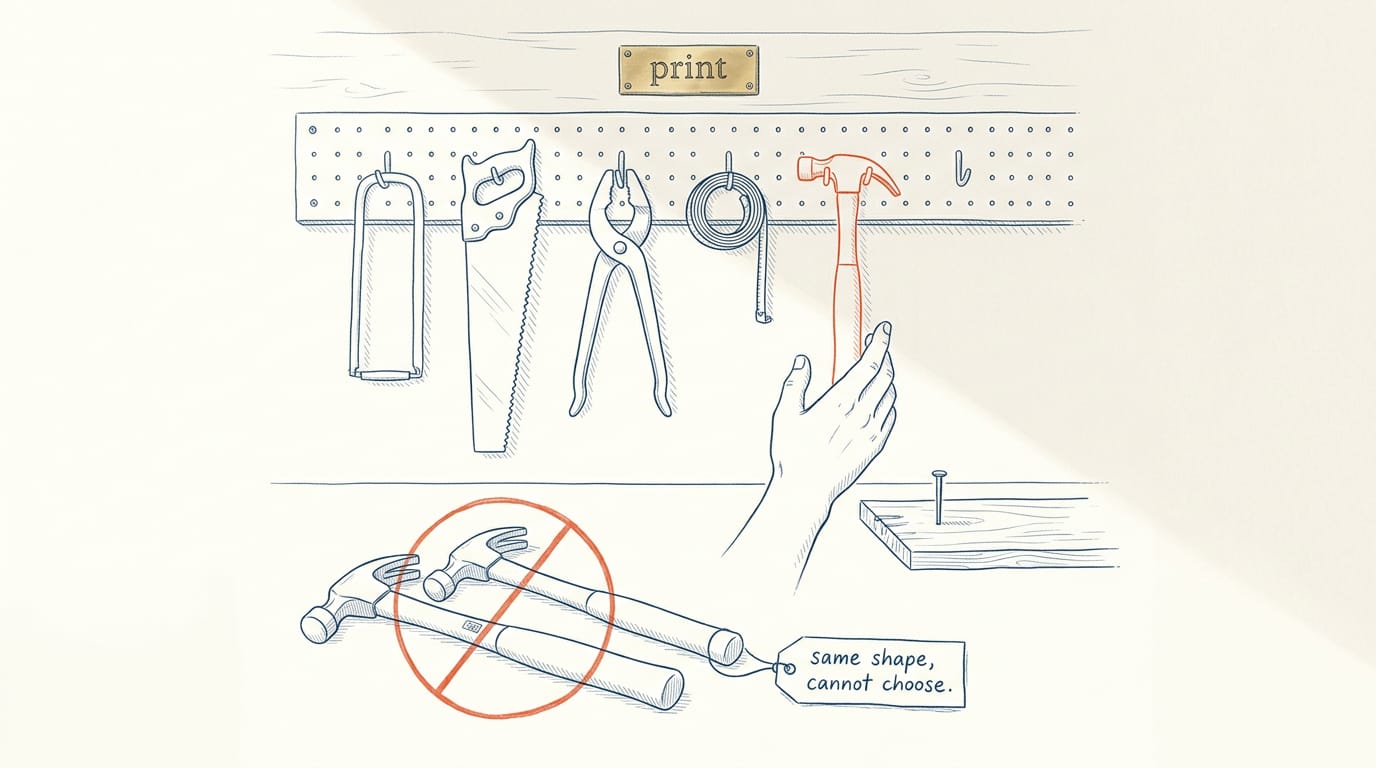
Imagine a coffee shop where the same word, coffee, gets you a different drink depending on whether you add milk, ask for it iced, or name a size.
Function overloading works the same way: one function name, several parameter lists, and the compiler picks the best match at each call site.
In this post, we’ll cover what makes two signatures distinct, how overload resolution picks a winner, and where overloading helps or hurts. Each C++ feature is tagged with the standard it needs, so you know what your -std flag will accept.
What Function Overloading Means
This section covers what the term means and where it fits.
One name, different parameter lists
Function overloading lets you declare several functions with the same name in one scope, as long as their parameter lists differ. The return type alone doesn’t count.
Consider a firmware developer writing a logging helper with log(int), log(const char*) and log(float). Call sites read log(retries) or log("link up"), and the compiler picks the match. No one needs log_int or log_str.
The same rule applies to methods and constructors. A Buffer class might take a size in one constructor and a size plus a fill byte in another.
There are two types: function overloading, which we’ve been discussing, and operator overloading, which gives operators like + or << a meaning for your own types. We’ll cover operators later.
A lone function isn’t overloaded. Add a second with a different parameter list and you have an overload set, the candidates the compiler chooses from. Two is the minimum.
How it relates to compile-time polymorphism
Overloading is often listed as a feature of object-oriented programming (OOP) because it lets one name take many forms, a property called polymorphism.
Overloading is compile-time polymorphism, sometimes called static polymorphism. The choice happens at compile time, not while the program runs.
The parameter list picks the version, so one name can behave differently for each argument type. A game engine programmer might write scale(Vector2) for sprites and scale(Vector3) for meshes, then call scale(velocity) and get the right code.
If no overload matches, the build fails, so the bug shows up before the game ever runs.
How to Overload Functions in C++
Overloading gives several functions one name, and the compiler picks the match by the arguments you pass, not by the name alone.
Ways the parameter lists can differ
Overloads differ in one of three ways:
- Number of arguments.
add(int, int)vs.add(int, int, int). - Type of arguments.
show(int)vs.show(double). - Order of arguments.
f(int, double)vs.f(double, int).
Rules and limits to keep in mind
- Same name required. Overloads share one name in one scope.
- Distinct function signatures. The name plus parameter types must differ, so
f(int)andf(const int)clash. - Return type alone is insufficient.
int f(int)anddouble f(int)clash, since a call likef(1);gives the compiler no way to choose. - Avoid ambiguous calls. If two overloads tie for the best match, the call won’t compile.
- Default arguments.
void log(int, int = 0)already acceptslog(1), so a separatelog(int)makes that call ambiguous. - Overloading on const and references. A const member function can share a name with a non-const one, and
T&andT&¶meters are distinct. - Block conversions with = delete (C++11).
void show(double) = delete;turnsshow(2.5)into a compile error instead of a silent conversion toshow(int).
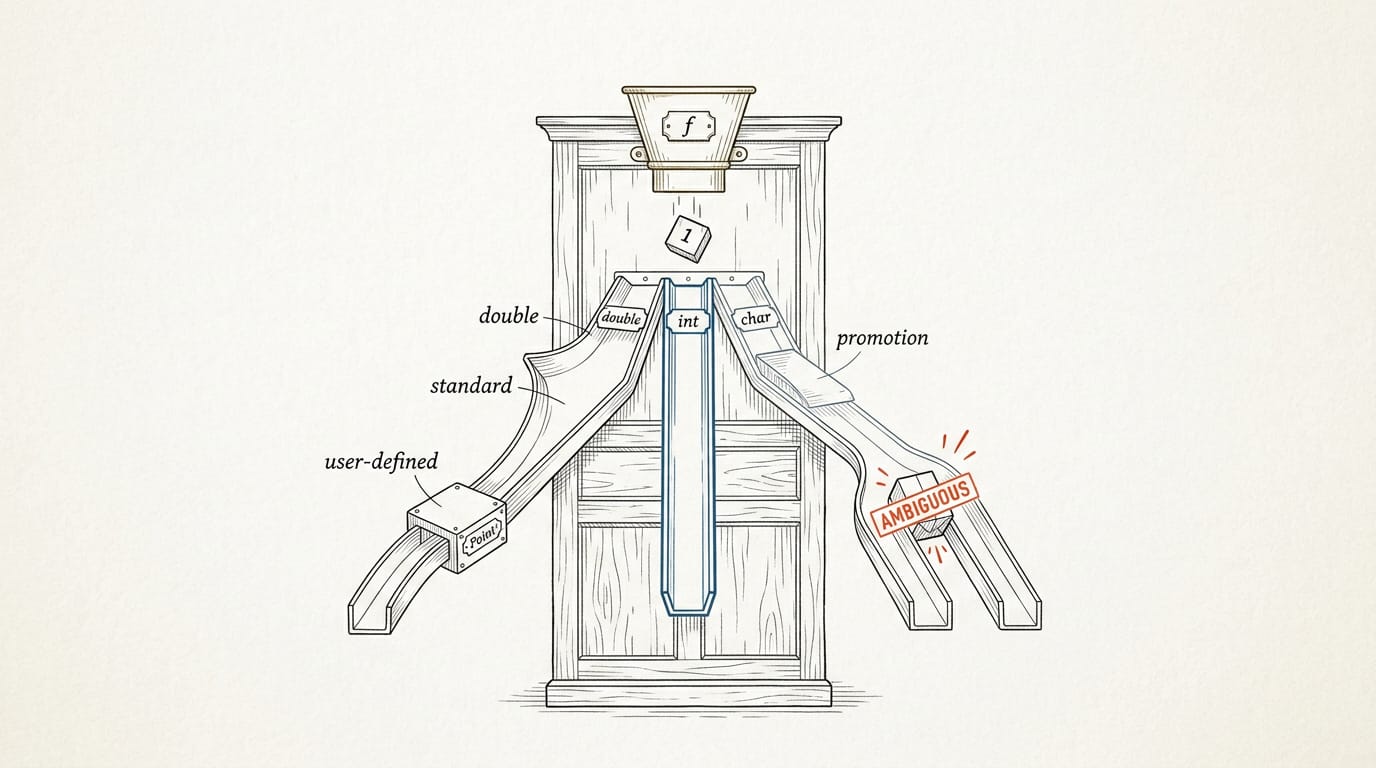
Overload resolution ranks candidates in order: an exact match beats a promotion (char to int), which beats a standard conversion (int to double), which beats a user-defined conversion. The best-ranked candidate wins. A tie is a compile error.
Add, sum, and show examples in code
Consider a game engine programmer who wants one sum for whole numbers and decimals. Overloads deliver that, so there’s no sum_int and sum_double pair to keep in step.
#include <iostream>

int add(int a, int b) { return a + b; }
int add(int a, int b, int c) { return a + b + c; }
int sum(int a, int b) { return a + b; }
double sum(double a, double b) { return a + b; }
int product(int a, int b) { return a * b; }

void show(int v) { std::cout << "int: " << v << '\n'; }
void show(double v) { std::cout << "double: " << v << '\n'; }
void show(const char* s) { std::cout << "text: " << s << '\n'; }

int main() {
    show(add(1, 2, 3));
    show(sum(2.5, 1.0));
    show(product(4, 5));
    show("hi");
}
— end example]
Output:
int: 6
double: 3.5
int: 20
text: hi
— end example]
Function templates join the overload set too. Add template<typename T> void show(T) and a plain function still wins an equal match, so show(42) calls the int version.
Constrain a template with a C++20 concept, such as template<std::, to limit which types it accepts.
Overloading Operators for Your Own Types
Operator overloading gives operators a meaning for your own types.
Giving operators a new meaning
Write a function named operator plus the symbol, such as operator+. The compiler calls it when that symbol touches a user-defined type, a class or enum your program defines. You’re only changing that type, so + on two ints still adds.
A game engine programmer’s Vec2 can use position = position + velocity * dt;, which reads like the physics formula, not a chain of add() and scale() calls.
Which C++ operators can be overloaded?
Most of them, with three rules: no new symbols, no change to precedence or operand count, and at least one user-defined type operand per overload. Here’s the full list, grouped by use:
- Arithmetic and bitwise:
+ - * / % ^ & | ~ << >> - Logical and comparison:
! && || == != < > <= >= <=>(<=>needs C++20) - Assignment: `= += -= *= /= %= ^= &= |= <<= >>=“
- Increment, access, and other:
++ -- -> ->* [] () , - Memory:
new delete new[] delete[]
These can’t be overloaded: ::, ., .*, ?:, sizeof, alignof, and typeid.
An overload can be a member function or a friend function. A member gets the left operand implicitly, as its object, while a friend takes both explicitly. That’s why 2.0 * velocity needs a non-member such as a friend: a float can’t own a member function.
Overloading increment on a private counter
Prefix and postfix share the name operator++, so the postfix version takes an unnamed int to tell them apart. A firmware developer’s RetryCounter keeps count_ private, so callers can’t reset it:
class RetryCounter {
public:
    RetryCounter& operator++() { ++count_; return *this; }
    RetryCounter operator++(int) { RetryCounter old = *this; ++count_; return old; }
private:
    int count_ = 0;
};
— end example]
The prefix form returns a reference to the updated object, while the postfix form returns a copy of the old value. Callers never touch count_ directly. The = 0 initializer needs C++11.
Where It Helps and Where It Hurts
Overloading buys clearer call sites, but it adds signatures everyone has to track. Here’s the trade.
Where overloading pays off
- Readability and consistency. One name for one operation beats printInt, printString, and printVector. Callers learn one verb.
- Reusability and modularity. Generic code calls serialize(x) without knowing the type of x, and a maintainer adds one overload per message type while the retry logic never changes.
- Type safety via compiler. Every call is checked against the overload set before the program runs, so a mismatch fails at build time, not in a crash report.
- Claimed speed and memory gains. Overloading is often credited with faster, leaner code. The authors of The Simple Essence of Overloading, in Proceedings of the ACM on Programming Languages, call static overloading a zero-cost abstraction: calls resolve at compile time, so the overhead of dynamic dispatch disappears. Their argument concerns speed, so measure your own code before you count on either gain.
- Easier maintenance. Adding a type usually means one new overload, and existing calls stay as they are.

Downsides to watch out for
- Ambiguous calls and errors. If a call converts equally well to two overloads, the compiler refuses to choose. An int passed to overloads taking long and double is a classic case.
- Higher complexity. Every overload is another signature to read. A reviewer might spot a new log overload that looks harmless, yet existing calls now resolve to it.
- Harder debugging and maintenance. You may have to work out which overload the compiler picked, and an edit to one can quietly shift calls to another.
Overloading works best when a reader can predict each call. The goal is clear overloads, not many ones. Keep the set small.
Function Overloading in Plain C
C has no function overloading, so one name serving several types needs a workaround. Here are four common ones, from a C11 keyword to plain function pointers.
Why C has no overloading
C maps each function name to exactly one definition. There’s no name mangling, the step C++ uses to give each overload its own linker name, so symbol names stay simple and stable for linkers and foreign-language interfaces.
When C++ code calls a C function, it wraps the declaration in extern "C", which turns off overloading and keeps the plain name intact. A C++ developer wrapping a legacy math library does this so the C side needs no changes.
Using C11 _Generic to pick by type
C11 added _Generic, which performs compile-time type selection: it picks a branch by the type of its controlling expression. A print_value macro can give int, double, and const char * one branch each, all behind a single call-site name.
The choice happens at compile time, so there’s no runtime overhead. One requirement: you need a C11 mode, such as -std=c11 with the GNU Compiler Collection (GCC) or Clang.
Variadic functions with flexible argument counts
A variadic function takes a varying number of arguments, marked with an ellipsis (...), and you read them through va_list and the va_start, va_arg, and va_end macros in <stdarg.h>. One logging helper can take two fields on one call and seven on the next.
The catch: the compiler doesn’t check types. Read an int where the caller passed a double, and you’ve triggered undefined behavior, which means the language promises nothing about what happens next.
Choosing behavior with function pointers and void*
Here the caller makes the choice, not the compiler. A function pointer stores a function’s address, so you can keep a table of handlers and call the right one by tag.
Consider a library maintainer writing an event queue in C89: each event carries a tag and a void * to its data, and the handler table maps each tag to the function that knows that type. The same code builds on C89 and C99 compilers.
The price falls on you. Casting the void * back to the right type is your job, and the compiler can’t verify the tag. Your tags have to be right.
C Versus C++ and Picking an Approach
C and C++ handle overloading differently, so the right choice depends on which one you compile.
Side-by-side differences at a glance
- Native overloading: C++ lets several functions share a name when their parameter lists differ. C has no overloading, so each function needs its own name, like
print_intandprint_double. - Type safety: C++ picks the overload that matches the argument types and rejects any call that matches none. Most C workarounds don’t check that for you, so a wrong type can slip through.
- Default parameters: C++ lets trailing parameters have default values. C doesn’t, so you write wrapper functions or pass sentinel values.
- Runtime dispatch cost: C++ resolves overloads at compile time, so the call costs nothing extra. A C workaround that picks at runtime adds a branch or an indirect call.
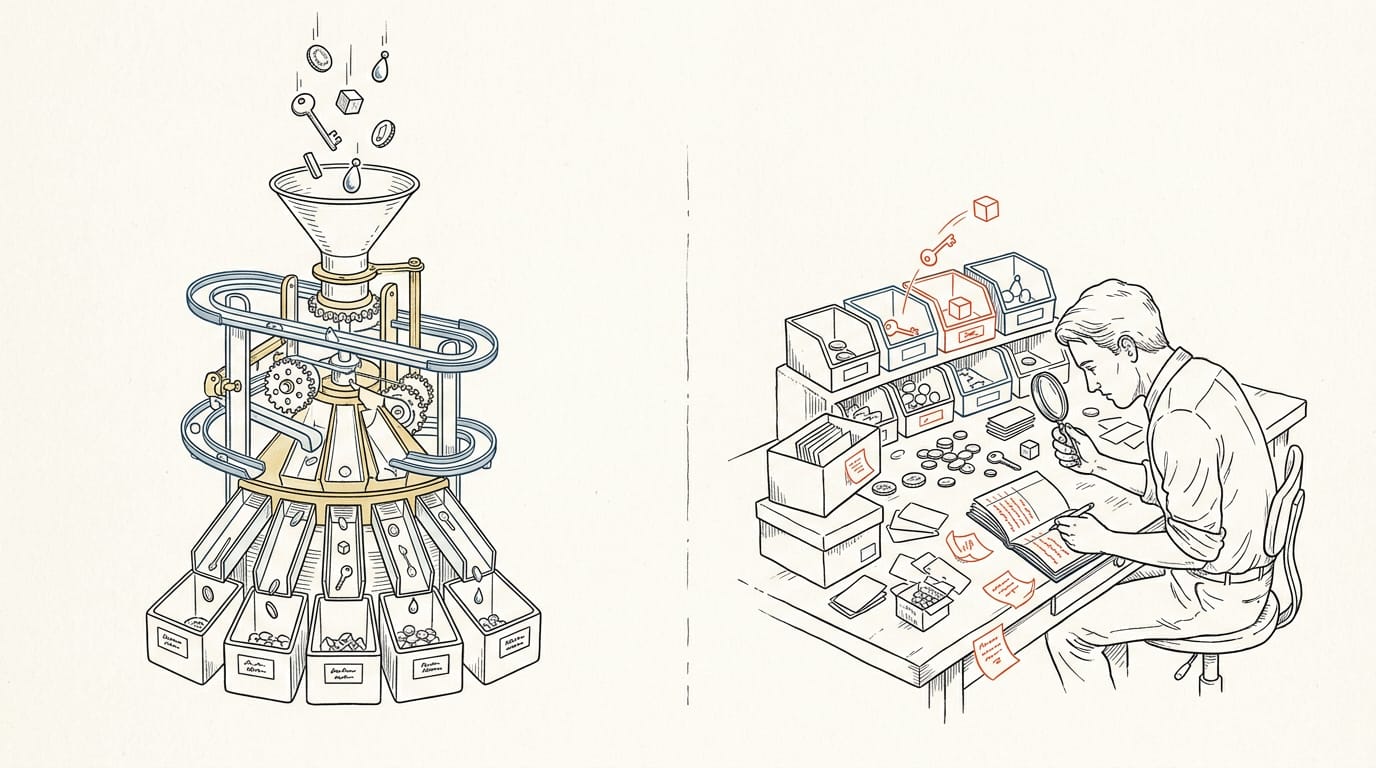
In C++, the compiler does the picking. In C, you do.
Which approach fits which situation
_Genericfor fixed arguments: C11 added_Generic, which picks by argument type at compile time. A firmware developer’slog_valuehelper takes anint, afloator aconst char *, and one macro routes each to its printer, so the team reviews one place instead of every call site.- Variadics for varying counts:
<stdarg.h>takes any number of arguments but can’t see their types, so caller and function must agree on them. - Function pointers for runtime selection: Store a pointer to the right function and call through it when the choice depends on input known only at run time. Each call costs a little more than a direct one.
- Switch to C++ if possible: If your build allows it, that’s the simplest path. The same helper becomes a few overloads, and the compiler checks every call.
Interview Prep and Common Questions
Overloading is a favorite screening topic, so here are the doubts you’ll hear most.
Quick answers to the usual doubts
C doesn’t support overloading. Two functions with the same name in one scope fail to compile. The usual workarounds are distinct names or the _Generic keyword from C11, which picks a function by argument type.
Name-mangling encodes each function’s parameter types into its linker symbol, so void f(int) and void f(double) get different names. Mangling schemes vary by compiler, so C code can’t call those names directly.
Declaring the C-facing functions extern "C" turns mangling off for them, which is also why an extern "C" function can’t be overloaded.
Partly. Variadic macros (C99 and C++11) can count arguments and dispatch to helpers, but they skip type checking and can evaluate an argument twice. A real function is usually the safer choice.
Yes, it’s often called static polymorphism. Overload resolution happens at compile time, so the compiler commits to a function before the program runs. Virtual functions are the runtime counterpart, chosen as the program runs.
Not for overloads. The return type isn’t part of the signature, so two functions that differ only in return type won’t compile. That’s a hard rule, not a style choice. If you want to see a signature without its body, a function type is the next thing to read.
Why interviewers ask about it
Overloading packs several skills into one question: signatures, resolution, and what the compiler actually emits. That’s why it’s a staple of placement technical rounds.
Consider a firmware candidate whose team ships C code into a C++ build. Asked whether C supports overloading, the candidate who says no and then names _Generic or a distinct name turns a trick question into a talk about the real codebase.
- C vs C++ confusion. Saying “C has overloading too” is the mistake interviewers listen for. Keep the two languages straight in your answer.
- Related C interview questions. Expect follow-ups on linkage,
extern "C", and macros.
Overloading lets one name serve several jobs, as long as each version’s signature is distinct. Overload resolution follows fixed rules, so the match you expect is usually the one you get, and operator overloading applies the same idea to your own types.
Plain C has no overloading, so its workarounds rely on distinct names and other tricks. Whichever route you take, keep the overload set small enough that a reviewer can see which version each call will hit.
Overload for clarity, not cleverness.
References
Questions
What is overloading and its types?
Overloading lets multiple functions share a name when their parameter lists differ; the compiler selects the best match for each call. Its two types are function overloading, which uses different parameter lists, and operator overloading, which defines operators for user-defined types.
How can I overload operators in C++?
In C++, define a function named `operator` followed by the symbol, such as `operator+`, as a class member or a non-member function. The overload must involve at least one user-defined type, and it cannot change the operator’s precedence or number of operands.
Is function overloading possible in C language?
No. C does not support function overloading, so each function name can have only one definition; common alternatives include distinct function names or C11’s `_Generic` for compile-time selection by type.
Which of the following supports function overloading * C C++ both none?
C++ supports function overloading; C does not. So the correct choice is C++.
Which C++ operators can be overloaded?
Most C++ operators can be overloaded, including arithmetic, comparison, assignment, increment, call, subscript, and memory operators. The operators `::`, `.`, `.*`, `?:`, `sizeof`, `alignof`, and `typeid` cannot be overloaded.