Performance[perf]
What Is the LLVM Compiler? A Complete Guide

- Section
- Performance [perf]
- Published
- Length
- 8 min read
In this answer6 clauses
- 1What the LLVM Compiler Is and Does
- 1.1What does LLVM stand for?
- 1.2The problem LLVM was built to solve
- 2How LLVM Is Built in Layers
- 2.1How frontend, IR, and backend stay separate
- 2.2What makes the intermediate representation flexible
- 3Hands-on Work with LLVM
- 3.1Using LLVM from C++, C, or Rust
- 3.2Bringing LLVM to a new architecture
- 3.3How LLVM releases reach users
- 4Where LLVM Shows up in Real Projects
- 4.1Compilers for Swift, Rust, and Clang
- 4.2Compiling code on the fly at runtime
- 4.3Ways LLVM makes code run faster
- 4.4Tools built on LLVM beyond compilers
- 5Where LLVM Falls Short
- 5.1Things LLVM does not provide for you
- 6References
Abstract
LLVM is a collection of reusable compiler tools that transforms code through an intermediate representation into machine code for different processors. A language-specific frontend such as Clang parses the code, shared LLVM optimizers transform it, and a target-specific backend generates the output; GCC is a separate compiler suite. This modular design lets languages and processor targets share compiler components, while making it easier to inspect optimization and identify which toolchain part handles a problem.
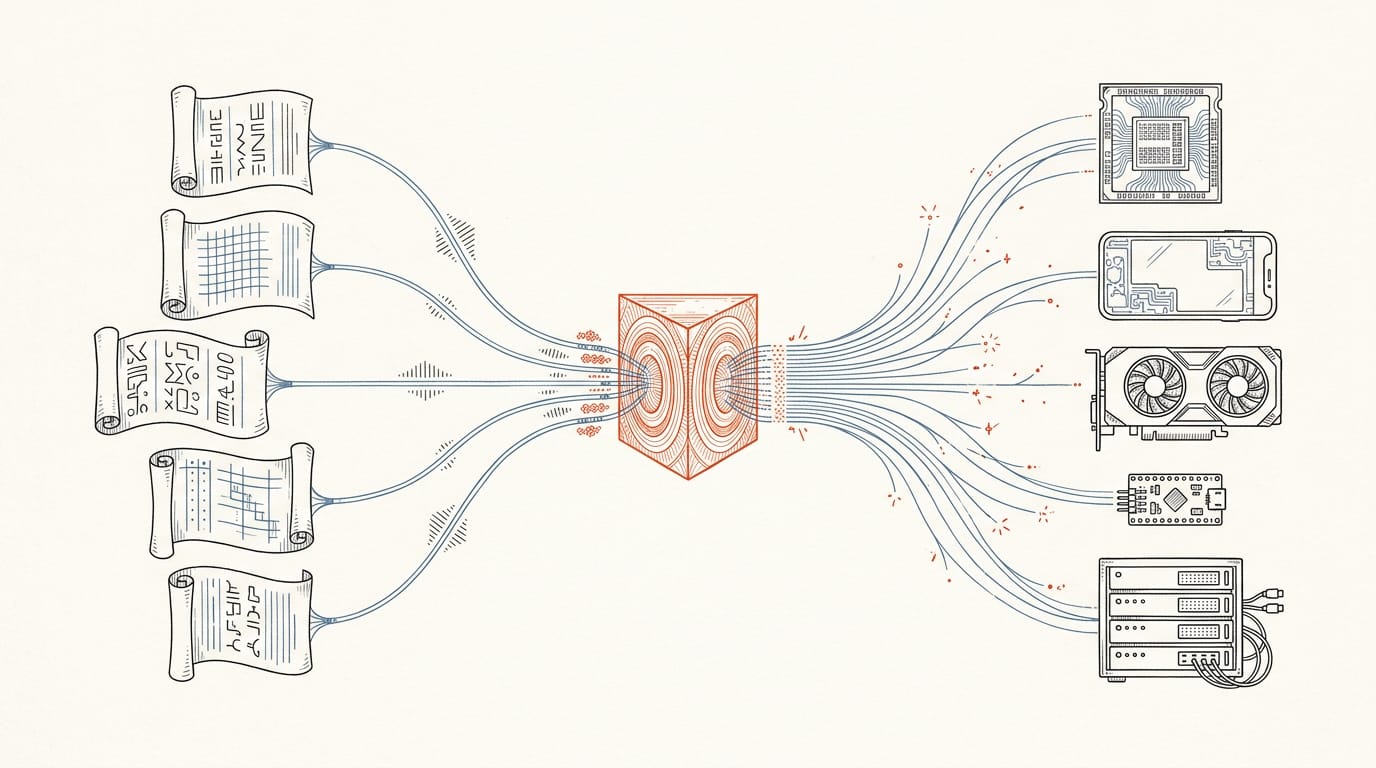
Think of a translator who speaks to many listeners at once. You hand over one message, and every listener hears it in their own language.
That’s roughly what a compiler does for your code, and LLVM is a compiler infrastructure: a set of reusable parts that turn source code into machine code for many different processors. The next step is seeing how a compiler differs from an interpreter.
Clang, the frontend that parses your C++ and hands it to LLVM, is one of those parts. Knowing how the pieces fit together helps you read compiler errors and judge what the optimizer changes. We’ll also show you how to watch that work in your own builds.
What the LLVM Compiler Is and Does
Before you can read compiler output with confidence, you need the basics. Let’s start with the name, then the problem LLVM was built to solve.
What does LLVM stand for?
If you were hoping for the letters spelled out, the more useful answer is what the project is. LLVM is a compiler infrastructure project: it’s less about one compiler and more about the parts you use to build many.
Its modular toolchain technologies are open-source and reusable, and they include a library with an API for the intermediate representation (IR), the form a compiler uses between reading your source and generating machine code.
The problem LLVM was built to solve
Consider a firmware developer whose team supports three chip families and two languages. Without shared infrastructure, that’s six separate compilers to build and keep in step. Add a third language and that’s three more to write.
According to a research paper on enhancing the Clang compiler, LLVM’s approach reduces that count from O(n^2) to O(2n). In Big-O notation, O(n^2) means the count grows with the square of the input, while O(2n) grows in a straight line.
That’s far fewer compilers to keep alive.
Here’s what that shared approach gives you:
- No compiler per language. One shared infrastructure serves many languages, so you don’t start from scratch for each one.
- Compiler creation is automated. The infrastructure handles much of the repetitive work, so you spend less time on plumbing.
- A portable framework for new targets. A new chip means writing a backend, the piece that generates machine code for one target, instead of starting over.

How LLVM Is Built in Layers
LLVM splits a compiler into stages, each with one job, so a new language or chip doesn’t mean rebuilding everything.
How frontend, IR, and backend stay separate
It works in stages:
- Language-specific frontend. Clang reads C++ and produces IR.
- Language-independent intermediate representation (IR). A shared middle form with no C++ syntax left in it.
- Machine-specific backend. It optimizes the IR for a target such as x86-64 or ARM and emits machine code.
- Components reused across languages. Every frontend emits the same IR, so one optimizer and set of backends serves them all.
Picture a firmware developer who tuned a hot loop on x86 and now needs it on ARM. The source and frontend stay put, and only the backend changes for the new board, so the hot loop doesn’t need a rewrite.
Is GCC built on LLVM? No, it isn’t. GCC is a separate GNU Project compiler with its own frontends and optimizer, so it doesn’t use LLVM’s IR or backends. Clang and GCC can compile the same source, but they take different internal paths.
What makes the intermediate representation flexible
The IR works like portable high-level assembly. It has typed instructions such as add and load, but it isn’t tied to any one processor.
- Architecture-neutral. It names no registers or instruction encodings, so one IR feeds many targets.
- Not limited by hardware bit width. Integers can be any width, such as i7 or i128.
- Multi-pass transformations. The optimizer runs many small passes, each rewriting the IR.
The IR captures what the code computes, not how a given CPU runs it. That separation is the whole point.
Here’s what we get from int add(int a, int b) { return a + b; } at -O0 (no optimization), trimmed:
define i32 @_Z3addii(i32 %a, i32 %b) {
entry:
  %a.addr = alloca i32
  %b.addr = alloca i32
  store i32 %a, ptr %a.addr
  store i32 %b, ptr %b.addr
  %0 = load i32, ptr %a.addr
  %1 = load i32, ptr %b.addr
  %add = add nsw i32 %0, %1
  ret i32 %add
}
— end example]
Compile with -O2 and the allocas, stores and loads vanish, leaving one add and a return. Try clang++ -S -emit-llvm -O2 add.cpp to see it yourself.
Hands-on Work with LLVM
Working with LLVM looks different when you call it, extend it, or upgrade it.
Using LLVM from C++, C, or Rust
LLVM is written in C++, so its libraries feel most natural from C++. If your tool is written in C, LLVM provides libraries callable from C, and Rust bindings are available too.
Bringing LLVM to a new architecture
Adding a new chip means building a new backend, the part of the compiler that generates machine code for one target. The documentation is sparse for beginners, so reading an existing backend is often your best teacher.
- Start with the assembler, so the chip’s instructions parse and encode correctly before you touch code generation.
- Build and test incrementally, adding one piece at a time and running its tests before moving on.
You’re after working output at each step, not a finished backend on day one. A small, well-known target like the Z80 or Intel 8080 makes a manageable first project.

How LLVM releases reach users
The current version is 23, as Arm’s community blog confirms with the 23.1.0 release on August 26, 2026.
LLVM ships a major release every six months, and the LLVM-Bench study shows that rhythm with four major versions, 18 through 21, over the past two years.
Fedora includes LLVM in its toolchain, and other systems often use it internally, so you may already rely on it.
The question isn’t whether LLVM supports a feature but which Clang release does. Consider a build engineer moving from -std=c++17 to -std=c++20.
They check which Clang release supports each C++20 feature the code uses, then pin that version in the build pipeline. No surprises on release day.
Where LLVM Shows up in Real Projects
Three names come up constantly: LLVM is the infrastructure, Clang is the C++ frontend that feeds it, and GCC (the GNU Compiler Collection) is a separate suite, so Clang and GCC are alternatives, not layers of one stack.
Compilers for Swift, Rust, and Clang
Clang is an ahead-of-time (AOT) compiler, turning your source into machine code before the program runs. Swift and Rust also build on LLVM, and the same machinery serves domain-specific languages (DSLs) too. Does Google use LLVM?
We can’t confirm that from a reliable source, so we won’t guess. Check Google’s own engineering write-ups before you cite it.
Compiling code on the fly at runtime
A just-in-time (JIT) compiler generates machine code while the program runs.
Julia uses LLVM for JIT compilation, and a research paper on Julia’s LLVM-based JIT notes that this can match the runtime speed of other compiled languages such as C. Numba brings the same idea to Python. Same engine, different timing.
Ways LLVM makes code run faster
LLVM’s optimizer runs passes over the intermediate representation (IR), the form between your source and machine code. At -O2 you’ll notice these most:
- Function inlining: a call is swapped for the function’s body.
- Dead code elimination: code whose result is never used gets removed.
- Loop unrolling: the loop body repeats, so there are fewer loop checks.
- Configurable optimizations: flags such as -O0 through -O3 set how hard the optimizer works.
Picture a game engine programmer who wraps a tiny vector-length helper around a hot loop. At -O2, the compiler usually inlines it, so the loop stops making a call per element.
To see this yourself, run clang++ -O2 -S -emit-llvm vec.cpp -o vec.ll (-S gives readable text, not binary bitcode), then check whether the call survived. Repeat with -O0 and compare.

Tools built on LLVM beyond compilers
LLVM’s reach goes past compilers:
- Emscripten and WebAssembly: a route for running C++ in a browser.
- MLIR (Multi-Level Intermediate Representation): a project for compilers with several IR levels.
- Static analysis tools: inspect code without running it.
- Emulation environments: run binaries built for one machine on another.
- clang-tidy, sanitizers, and clang-format: linting, runtime bug checks, and formatting.
Where LLVM Falls Short
LLVM is powerful, but it isn’t a complete compiler on its own. Seeing what it leaves out keeps you from expecting a feature that isn’t there.
Things LLVM does not provide for you
Here’s what falls outside its scope:
- Language grammar parsing. Turning your source text into a structure the compiler can reason about is the job of a frontend, a separate component built for each language. For C++, that’s Clang.
- Package or toolchain management. LLVM won’t fetch your dependencies, pin a compiler version, or set up a cross-compile sysroot. Your build system and package manager handle that.
- Native garbage collection. LLVM won’t track which objects are still in use and free them for you. In C++, that job stays with you, usually through RAII (resource acquisition is initialization) and smart pointers.
- A frontend for every language. LLVM supplies the optimizer and code generator, but each language you compile needs its own frontend to parse it.
- Uneven frontend maturity. Frontends don’t all mature at the same pace, so how complete a language’s support is depends on the frontend you choose.
Consider a build engineer who gets a wall of template errors from one header. The message comes from Clang’s frontend, not from the optimizer, so the fix lives in the code or the flags you pass to Clang.
Knowing which piece owns a problem tells you where to look, not just that something went wrong.
LLVM is a set of shared compiler parts: a frontend such as Clang that turns your C++ into an intermediate representation (IR), an optimizer that reshapes it, and a backend that emits machine code for your target.
Once you can see each stage, the compiler stops feeling like a black box.
Start with a small file, then try the same steps on a real module in your build. Each glimpse of the IR or generated assembly teaches you something about the code you ship.
The compiler isn’t a black box anymore. Now you have the tools to look inside.
References
- Enhancing The Clang Compiler with OpenMP Parallelism: A Novel Approach using ClangIR — hdl.handle.net (2024)
- LLVM-Bench: Benchmarking and Advancing Large Language Models … — arxiv.org (2026)
- JACC: Leveraging HPC Meta-Programming and Performance Portability with the Just-in-Time and LLVM-Based Julia Language — osti.gov
- Arm Community — developer.arm.com (2026)
Questions
What is a compiler in C?
A C compiler translates C source code into machine code or another lower-level form that a computer can execute. It typically parses the source, optimizes it, and generates code for a target processor.
What is the current status of C++26?
C++26 is the planned next C++ standard, following C++23. Its finalization and publication timeline is in progress, and its exact features depend on the standardization process and compiler implementations.
What is the Clang format?
Clang-format is an LLVM-based tool that automatically formats C, C++, and related source code according to configurable style rules. It can apply a project’s style consistently across files.
Does Google use LLVM?
Yes. Google uses LLVM in some projects and tools, though its use varies by product and team. Google also develops and uses other compiler technologies, so it is not accurate to say all Google software relies on LLVM.
What does LLVM stand for?
LLVM originally stood for “Low Level Virtual Machine,” but it is now the name of a compiler infrastructure project rather than an acronym. Its reusable components include an intermediate representation, optimizers, and code-generation backends.
Is GCC written in C or C++?
GCC is written primarily in C and C++. Its development has used C++ for parts of the compiler, while much of GCC’s codebase and compiler infrastructure remains in C.
Is GCC built on LLVM?
No. GCC is a separate GNU Project compiler with its own frontends, optimizer, and backends; it does not use LLVM’s intermediate representation or code-generation backends.
Sources
- Enhancing The Clang Compiler with OpenMP Parallelism: A Novel Approach using ClangIRhdl.handle.net,
- JACC: Leveraging HPC Meta-Programming and Performance Portability with the Just-in-Time and LLVM-Based Julia Languageosti.gov
- Arm Communitydeveloper.arm.com,
- LLVM-Bench: Benchmarking and Advancing Large Language Models ...arxiv.org,